
Levitating Frogs and People
The Surprising Magnetic Properties of Biological Matter (from the Archive)

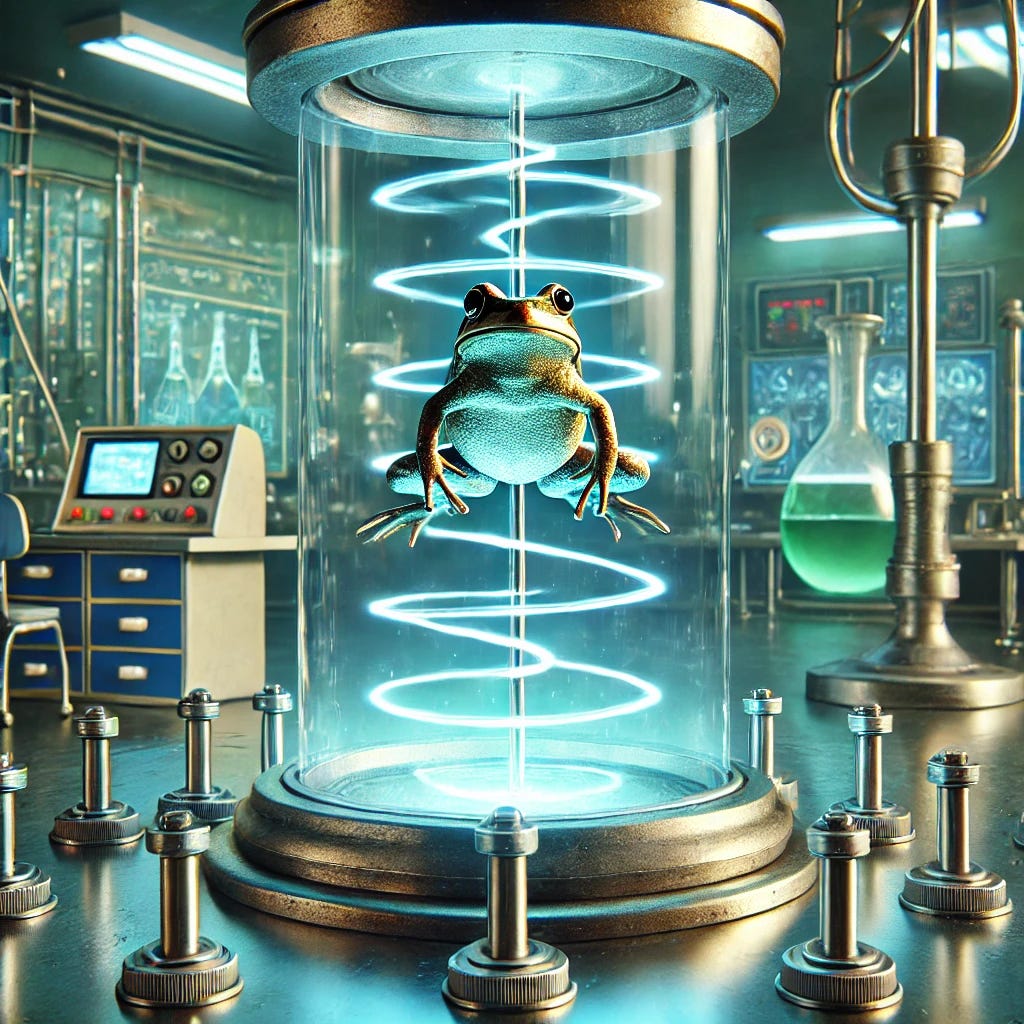
My Electromagnetic Fields course is about to cover magnetism, so I thought I’d revisit an old post from my Diary of Numbers blog. I’ve updated the numbers from the previous post to be a bit more accurate.
To the outside observer, it may seem that scientists hate frogs. Perhaps it’s true. After all, they’re green, slimy, and, with a little salt, they can enter zombie mode.1 That’s probably not enough to justify dissection, but perhaps it’s enough to justify this:
Now, I know what you’re thinking. It's a frog. Levitating. In a magnetic field. WTF?!?!
Frogs aren’t normally magnetic. However, frogs (and other living creatures) contain water, which is a diamagnetic material.2 Diamagnetic materials have this weird property: when you place them in a magnetic field, they turn into a magnet themselves. The new magnet points in the opposite direction of the first magnet. In this way, a diamagnetic material is like a magnet that always repels. Normally, this effect is very weak, but NASA scientists have shown that if you have a very big magnetic field, you can generate a magnetic force that is strong enough to lift everyday objects like frogs. Now you might wonder why NASA cares about levitating frogs...

In truth, they’ve levitated more than just frogs. Their goal seems to be eventually levitating a human. This, of course, would be one way to mimic the effects of zero gravity. How large a magnetic field would it take to lift a human?
According to Wikipedia, it takes about 16 Tesla of magnetic field to levitate a frog. For comparison, an MRI machine, which can erase all your credit cards if they’re in the same room, has a magnetic field of 3 Tesla.
The magnetic field serves two purposes. First, it “magnetizes” our prospective astronaut.3 The amount he gets magnetized will be roughly proportional to the magnitude of the magnetic field. After magnetizing the astronaut, the magnetic field will then push him up with a force that depends on both its own value and the value of the astronaut's magnetization. Since the field appears twice in the force we can say that the force is proportional to the field squared: Force ~ (magnetic field)2.
A frog might weigh around 20 grams, which is roughly 3,500 times less than a human. To generate 3,500 times the upward force, you’d need a field that’s about 59× stronger. (You can see this by squaring 59 to get roughly 3,500 times the force.) For this reason, you’d need a field of approximately 59×16 Tesla = 944 Tesla—a magnetic field equivalent to about 315 MRI machines.
While the thought of levitating humans with massive magnetic fields is fascinating, the practical challenges are still enormous. Generating the kind of magnetic field strength required to lift a person is well beyond current technology’s everyday use—especially outside of specialized laboratory environments. Yet, these experiments give us a glimpse into the potential of magnetic fields to manipulate materials in surprising ways. As scientists continue to explore the extremes of magnetic forces, we may uncover applications that push the boundaries of what we thought was possible.
About the Author:
Aaron Santos is an innovator, author, and physicist. He’s written two books, How Many Licks? Or, How to Estimate Damn Near Anything and Ballparking: Practical Math for Impractical Sports Questions, which teach the art of estimation in fun and irreverent ways. He’s founded two nanoscience companies and is currently writing his third book, which explores the history, science, and future of nanotechnology. Interested publishers are encouraged to reach out.
Like what you're reading? Don't miss out on more absurd science adventures and entertaining deep dives into nanotechnology and beyond! Make sure to like, subscribe, and share the fun. Your brain (and sense of humor) will thank you!
Galvani’s reanimation of frog legs was a famous moment in science history that inspired Mary Shelley’s Frankenstein.
Other diamagnetic materials include gold, silver, copper, carbon dioxide, and bismuth.
It’s more accurate to say that the strong magnetic field interacts with diamagnetic materials in the astronaut’s body (like water) to produce a weak repelling force. This effect is proportional to the square of the magnetic field strength because both the induced magnetization and the force rely on the field’s magnitude.