
Santos’s Law
If It Exists, Someone Is Building a Generative AI Version of It


In preparing a talk on the future of AI, I was researching how generative AI is affecting different fields when I observed a peculiar phenomenon. Any time I typed “[field name] + generative AI” into the search bar, I saw someone was already building an AI tool for that field. Not as a joke or a concept, but a real product, often with a waitlist and demo video.
As a physics professor, I always wanted a law named after myself, and since no one was going to do that for me, I decided to make my own.
Santos’s Law: If it exists, someone is building a generative AI version of it.
Many of these you’ve likely seen. Generative video, music, voice, code, and websites are already everywhere. You type a prompt, and out comes a short film, a song, or a working website. These are impressive, but they’re just the first wave.
Here are some of the examples you might not have heard of yet:
Generative 3D Models
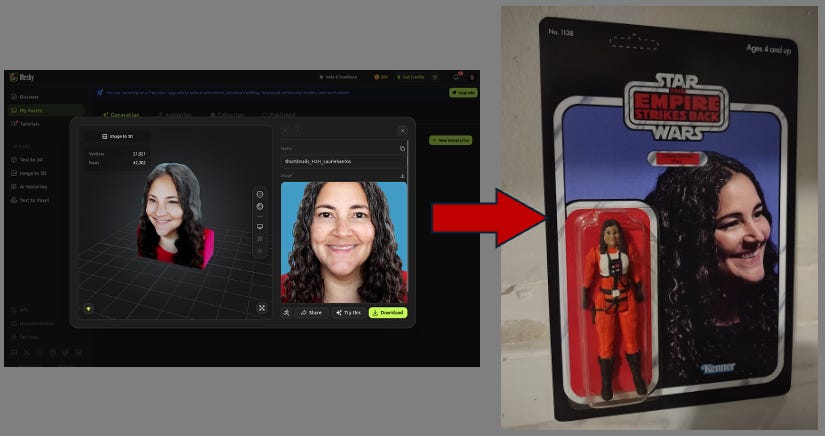
I wrote earlier about generative 3D model-builders in a piece titled On Toys and Tech. Tools like Meshy let you type something like “low-poly medieval tavern” and get a usable 3D (and 3D printable) asset in seconds.
What matters here is not just speed, it’s access. You no longer need a 3D artist to prototype a video game asset or even a physical object. Paired with a 3D printer, you get something close to “prompt to product.” The long pipeline from idea to production collapses to just a few simple steps.
Generative Data
This one is less flashy, but arguably more important. When I was leading a data science team, one of our biggest bottlenecks was always “we don’t have enough data” to train predictive models. That excuse is quietly disappearing. Generative AI is now being used to generate entire datasets. Not images or text, but structured data for training, testing, and simulation.
This is already happening in healthcare, finance, and autonomous systems. You can generate synthetic patient populations, financial scenarios, or driving conditions that would be hard, expensive, or unethical to collect in the real world. That data can then be used to train more AI, a bit like bootstrapping reality.
There are obvious risks here. Will the generated data actually reflect the real world or will it contain hidden biases? One can test this by benchmarking against domains where real data exists and checking whether models trained on synthetic data make the same predictions as models trained on experimental data. If synthetic data performs well, it provides enormous leverage and opens the door to an explosion of new models much faster, since you don’t need to do the time-consuming and expensive step of collecting large datasets.
Generative Product Design
Product design used to be a mix of creativity, engineering constraints, and a lot of iteration. You sketch something, build a prototype, test it, tweak it, and repeat. The bottleneck was always how many variations you could realistically explore. Now generative design tools are starting to brute-force that search process.
With systems like Autodesk Generative Design, you define constraints instead of drawing the object directly. Materials, cost, strength, manufacturing limits, environmental conditions. The system then generates hundreds or thousands of viable designs that satisfy those constraints, often including options no human would think to try. Architecture is a neat example of this. Instead of designing a building from scratch, imagine you specify things like load requirements, lighting goals, airflow, and cost, and the system proposes entire building layouts that meet those goals.
The shift here is subtle but important. It’s not that AI replaces designers. It’s that designers are no longer crafting a single solution. They define what a good solution looks like and then select from a generated landscape of possibilities. Product design becomes less about drawing and more about judging, steering, and occasionally saying, “well, I never would have thought of that, but it works.”
Generative PCBs

People often assume engineering jobs are safe from AI-driven displacement. They are not. Much of engineering is constraint-driven and prescriptive, which are exactly the kinds of problems generative AI excels at.
Consider printed circuit board (PCB) design. Platforms like Flux are already starting to automate layout and even parts of circuit design. Imagine wanting a new electronic device, describing what the board needs to do, and having the system generate layouts that satisfy those requirements. You send the file to a manufacturer, and a few days later the board shows up at your door.
Right now, generative PCB design is more assistive than magical, but the trajectory is clear. Hobbyists will shift from “I need to learn PCB design” to “I just need to describe the device I want clearly.” Professionals will spend less time drawing traces and more time validating and refining generated designs. It’s the same pattern again. Define constraints, generate candidates, pick the best one.
Generative Materials and Drugs
Imagine being able to describe the properties you want in a material and having a system propose candidates that actually work. Researchers are using generative models to design materials with specific properties: stronger, lighter, more conductive, more heat resistant, etc. Instead of designing from atomic first principles, researchers define the target behavior, and an AI model proposes molecular structures that might achieve it.
I’ve written previously about the nanotech book I’m writing. For decades, the nanotech vision was atom-by-atom assembly. In reality, that approach has massive technical barriers, but generative models offer a workaround. You simply say “find me molecules that behave like this,” and let the system explore a space no human could reasonably search.
Medicine is the most compelling example. Imagine being able to describe a disease and generate possible drug candidates. That is already happening. Systems are being trained to propose hypothetical drug molecules that match specific biological targets. Drug discovery shifts from testing one idea at a time to generating thousands of plausible options and filtering down to the ones that work best with the least side effects.
This does not replace researchers, but it changes the nature of their work. The bottleneck moves from “coming up with ideas” to “evaluating and validating them.” If this scales, it shortens drug development timelines and lowers costs.
Generative Games and Worlds
This is one of the most fun applications, and also one of the most inevitable. AI tools are already generating game assets, dialogue, and behaviors. You can imagine a near future where you describe a game and get something playable.
I’ve already toyed with a tiny version of this firsthand. Every year, I try to make my wife something for Christmas. This year, I got ambitious. Having lived together in five different states, we often bemoan the fact that our favorite places are spread out. As a small attempt to bring them together, I made her a goofy game called Cozy Town, where her avatar gets to stroll through an AI-generated cityscape with all our favorite old haunts (see above).
AI game dev tools are nowhere near “prompt and done,” but the amount of friction is greatly reduced. The game probably would have taken me a year and a half of concerted effort five years ago. Using only ChatGPT to generate the art and help with the coding, I was able to complete the project in about three days.
In the future, personalized games generated on demand, game worlds that evolve based on gameplay, and unscripted NPCs may all be possible.
Why Does This Keep Happening?
Generative AI is not just about images or text. The examples above show how it’s spreading across fields and data types. Any domain that can be represented digitally is a candidate for a generative tool, which partly explains why “Santos’s Law” is so pervasive.
However, technical capability only tells us that generative AI can be used in any field. The bigger question is, “Why is everyone using it?” It’s not because people are obsessed with slapping AI onto everything.1 I would argue it’s because of a broader push for democratization.
AI’s real power is that it lowers the bar for entry into spaces that used to require years of training. I never would’ve been able to design action figures or build video games in just a few days without it. AI tools won’t make everyone an expert—developing expertise still takes time—but it will enable you to start playing and building much earlier. You can learn as you create, with a relatively low-cost virtual partner guiding the process.
What used to require years of formal training can now begin with a rough idea and a prompt. That doesn’t eliminate expertise, but it changes where it matters. Rather than knowing how to execute every step, using generative AI requires knowing what to try, what to keep, and what to discard. This shift rewards a different kind of skill set. Rather than benefiting people who are good at executing well-defined processes, AI rewards curious people who like to experiment. These folks will benefit the most, because the cost of trying something new is so low. It takes little time to try something new. The more things they try, the more they’re likely to stumble across something truly innovative and valuable.
Ultimately, this is what Santos’s Law is about. It’s not about technology invading every field, but rather who gets to participate. It shifts creation from being a specialized skill of only a select few to anyone with creativity, a willingness to experiment, and the ability to distinguish good results from bad.
About the Author:
Aaron Santos is an innovator, author, and physicist. He’s written two books, How Many Licks? Or, How to Estimate Damn Near Anything and Ballparking: Practical Math for Impractical Sports Questions, which teach the art of estimation in fun and irreverent ways. He founded two nanoscience companies and is currently writing his third book, which explores the history, science, and future of nanotechnology. You can follow him on BlueSky.
Ok, it’s not just because people are are obsessed with slapping AI onto everything.